The evolution of the breakable target
As shooters we spend a lot of time thinking about the minutiae of our sport. We debate the ergonomics of a stock, the crispness of a trigger pull and the exact speed of a distant crosser. But we rarely stop to consider the target itself – that flying disc of pitch and limestone that teases and toys with us as it hurtles through the sky.
The modern clay target is a minor miracle of engineering, designed to fly true and shatter upon impact. It’s history is rooted in a series of bizarre, brilliant and sometimes brutal experiments.
The legend of The Old Hats Tavern
The mental challenge of breaking things in the air stretches back more than two centuries, though its origins were born out of practical hunting preparation rather than pure sport.
In the late 1700s, live birds were the only option for shooters looking to keep their eye in outside the hunting season.
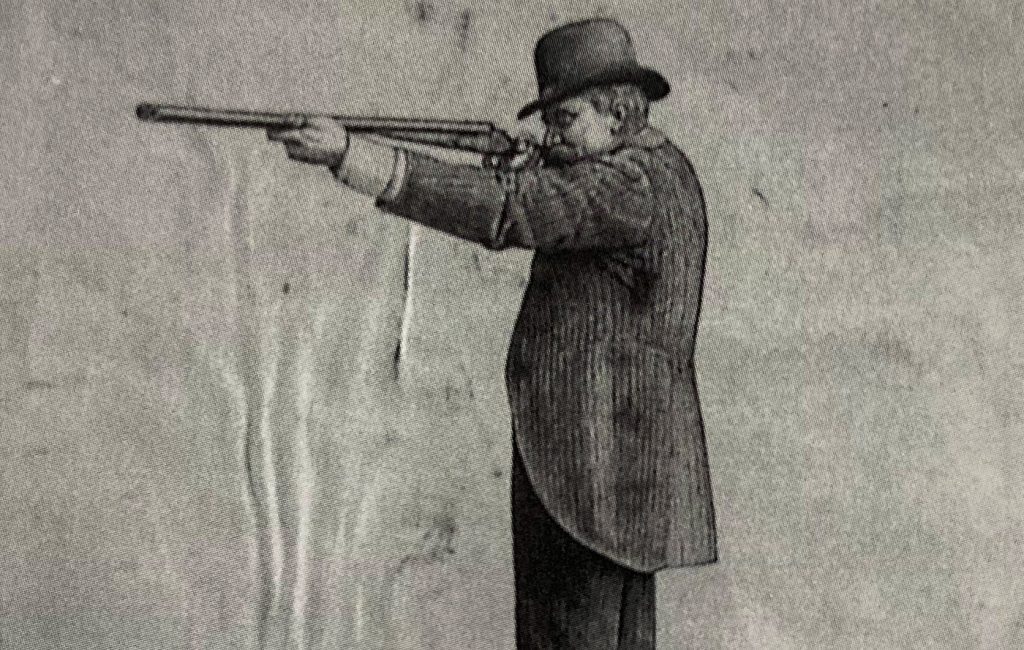
The birthplace of organised trap shooting is believed to be a London pub called The Old Hats Tavern. Shooters gathered there to test their skill against live pigeons and Passenger Blue Rocks, which were placed inside holes dug into the ground and covered with old hats. A string pulled the hat away, the bird took flight, and the shooter had to react instantly.
It was raw, unpredictable and undeniably effective for building muscle memory, but it lacked the consistency that we see today.
Mid-1800s experiments and the shift in welfare
As the 19th century progressed the sport grew rapidly, but it faced two major hurdles: a shortage of birds and a shifting cultural attitude towards animal welfare.
The Cruelty to Animals Act of 1835, alongside subsequent legislative updates, signalled a changing tide in British society. Shooters needed an alternative that could replicate the flight paths of live quarry without the ethical baggage.
The early alternatives were inventive but somewhat flawed. Inventors experimented with everything from mechanical wooden birds to balls made of baked clay and even cast iron. The challenge wasn’t making something fly; it was making something that would actually break when hit by lead shot.
Glass balls and the breakthrough of the 1880s
Before we arrived at the flat disc that’s thrown today, the shooting world went through a fascinating experiment with glass.
In the 1860s and 1870s, glass ball shooting became the standard. These hollow spheres, often filled with feathers or coloured powder to create a visible cloud upon impact, were flung from leaf-spring traps.
While popularised by exhibition shooters like Buffalo Bill and Annie Oakley, glass balls had a glaring design flaw. If you didn’t hit them dead centre, the pellets would simply glance off the curved surface, leaving the shooter frustrated and the ground littered with dangerous shards of sharp glass.
| Era | Primary target technology |
| Late 1700's | Live pigeons |
| Mid-1800s | Early prototypes (wooden and iron birds) |
| 1860s - 1870s | Hollow glass balls filled with feathers |
| 1880s | McCaskey & Ligowsky inverted clay saucers |
The real revolution arrived in the 1880s. An American inventor named George Ligowsky noticed children skipping flat stones across water and realised that an inverted saucer shape offered superior aerodynamics and a much better surface for shot retention.
At the same time, Fred McCaskey refined the raw materials, introducing a blend of river silt and pitch that could withstand the violent acceleration of a spring trap but shatter reliably when clipped by a single pellet.
And so the modern clay target was born.
Today we compete in a sport refined by centuries of trial and error, moving from the unpredictable flutter of a live bird to the predictable, engineering-led precision of the modern clay.
The next time you call for a target and watch it turn to dust, remember you’re participating in a tradition that took two hundred years to perfect. It puts a missed pair into perspective.