
The cost of situational awareness
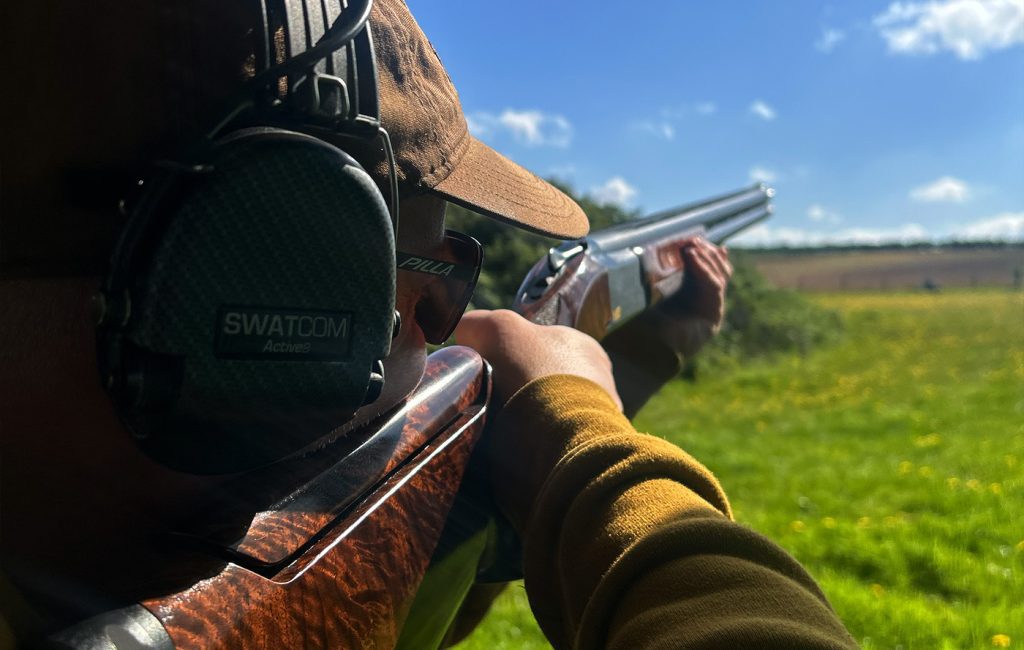
The mechanical efficiency of a clean gun mount relies on a thousand silent variables, but nothing compromises a smooth lift quite like a heavy lump of plastic slamming into the comb of your stock.
It’s a subtle disruption, a fraction of an inch of head displacement that shifts your focal point and turn smoked crossers into a clean pair of no-birds. Yet we routinely compromise our mount in the name of hearing protection, alternating between the bulky isolation of over-ear defenders and the silent, uncommunicative vacuum of foam plugs.
Striking the balance between preserving your hearing and maintaining an unobstructed mount requires looking beyond marketing metrics to understand how protection actually performs on the layout.
The anatomy of impulse noise
Modern clay target shooting sits in a precarious auditory position. A standard 12-bore cartridge unleashes a noise averaging between 140 and 160 decibels. Because the decibel scale is logarithmic, every increase of 3dB represents a doubling of sound energy; human hearing damage begins with prolonged exposure to 80dB, meaning a single unshielded gunshot delivers a catastrophic spike of pressure directly to the delicate hair cells of the inner ear.
Historically, the shooting grounds of the mid-twentieth century paid little heed to this reality. Early protection amounted to little more than stuffed cotton wool or rudimentary industrial plugs that did more to deaden conversation than block pressure waves. Today we rely on standardised metrics like the Single Number Rating (SNR) in Europe or the Noise Reduction Rating (NRR) in America to quantify protection. A device with a 50dB SNR theoretically reduces a 100dB blast to a more manageable 50dB.
The complication lies in the lab environments where these numbers are generated. Synthetic tests use perfectly fitted, static mannequins or tightly controlled human subjects sitting completely still.
The real world, however, is a dynamic environment of bodily movement and shifting surfaces.
The lab vs the ground
In practice, a lab rating rarely survives the walk to the first stand. That’s largely down to the physical reality of shooting gear. The thick temple arms of high-quality ballistic glasses routinely compromise the soft foam or gel seals of over-ear defenders, dropping the actual noise attenuation by up to 5 to 10dB.
On top of this of course, human anatomy varies wildly – and we’re not just talking about Big Dave’s belt size compared to Skinny George’s.
A pre-moulded plug that seals flawlessly in your ears on day one may over time start to leave microscopic gaps allowing acoustic energy to leak straight past the barrier. After all, our ears are the only body part that continues to grow and change over time.
The seal is everything and our body changes and dynamic movements constantly try to break it.
Choosing your acoustic barrier
Deciding how to shield your ears involves weighing ergonomics against situational awareness, which splits the field into two distinct categories.
Passive and electronic defenders
Traditional over-ear defenders provide robust, foolproof isolation. Passive models rely entirely on dense acoustic foam and a tight headband to seal off the ear. They’re incredibly reliable and require zero maintenance, but they completely isolate you from the environment you’re in, turning coaching instructions, squad banter or trap releases into muffled murmurs.
Active electronic defenders solve this isolation by using external microphones to pass ambient speech through to internal speakers, instantly cutting the feed or compressing the audio the millisecond a shot occurs. The payoff is physical bulk at times. Even slimline electronic muffs alter the geometry of a tight cheek weld, occasionally forcing you to tilt your head to avoid hitting the stock.
Passive and electronic earplugs
In-ear protection completely removes the stock-interference issue. Reusable passive plugs, often featuring internal acoustic filters, offer a lightweight profile that feels great, especially in hot weather where over-ear defenders can get a bit sweaty. (in the winter you’d welcome a good pair of defenders to keep your lugs warm though!)
The premium in-ear alternative is the active electronic moulded earplug. These sophisticated digital buds sit entirely within the ear canal, using advanced signal processing to amplify subtle environmental sounds while compressing harmful impulse noises. They give you the absolute freedom of an unrestricted gun mount alongside total situational awareness, though they require ear moulds to be taken before manufacture and meticulous cleaning to prevent earwax from degrading the delicate digital ports (sorry if you’re reading this while eating).
And they don’t last forever – ears change and grow as mentioned above.
To lay it all out in one place, here’s a quick guide…
| Protection type | Cost | Endurance | Benefits | Drawbacks |
|---|---|---|---|---|
| Passive defenders | £25 – £60 | 5+ years | Consistent, easy seal & low maintenance | Bulky. Can hinder your mount |
| Electronic defenders | £200 – £500 | 5–7 years | Ambient awareness, low maintenance apart from periodic charging | Hot ears in warm weather |
| Filtered plugs | £40 – £90 | 1–2 years | Low profile, lightweight and low cost | Universal fit, can mute conversations |
| Electronic custom moulded plugs | £500 – £1,000+ | 2–3 years | Perfect ergonomics (when made) | High cost, battery dependent |
The climate factor
Weather introduces a final layer of complexity to gear performance. On winter days, the plastic components of over-ear bands stiffen, altering the clamping force against your skull and subtly changing how the cups sit against your glasses but your ears will thank yo for the warmth.
Conversely, shooting under a blistering summer sun turns full-sized defenders into sweat traps, making your ears damp and adding a little distraction to the mix.
In-ear options handle temperature fluctuations far better, but they are highly sensitive to moisture. Heavy downpours can block the tiny acoustic ports of filtered passive plugs or threaten the delicate circuitry of non-waterproof electronic buds unless cleaned and dried thoroughly after the shoot.
Protecting your hearing is not optional, it’s just common sense. But choosing a lane and sticking to it has it compromises.
For us, defenders are our own lane of choice – but we do shoot a lot in the UK when that extra bit of warmth around our ears is very welcomed even in the ‘summer’ – whatever that looks like nowadays on this island…